Petroleum Calculation Series: Wedge Formula

marine-surveyor-wedge-formulaAs I have requested by comments to post about Wedge Formula of liquid cargo measurement, herewith the article collected from internet

What is Wedge Formula?
Wedge Formula is calculation to determine the small quantity of liquid or non liquid cargo (On Board Quantity – OBQ or Remaining On Board – ROB) on cargo tanks, where it should fulfill the following conditions :
– The vessel has huge trim, but there is no trim correction value available on the tank table,
– The liquid or cargo on tank is not touch one or more of the tank bulkheads,
– Observed sounding tanks at several points to ensure the cargo is not touch one of the tank bulkheads,

Continue reading “Petroleum Calculation Series: Wedge Formula”

Hold Cleanliness: Surveyor’s Inspection and Requirements

hold-cleanliness-marine-surveyors (2)Prior to loading grain, all ships are usually subject to a survey by an approved independent surveyor. The surveyor will require the ship’s particulars, and details of at least the last three cargoes carried. He will then inspect the holds for cleanliness and infestation, and the presence of any material that could lead to infestation or contamination.

When the surveyor is satisfied, he will issue the ship with a certificate to confirm that the holds are clean. However this is not a guarantee that the holds are perfectly clean and that no cargo claim will result.

Continue reading “Hold Cleanliness: Surveyor’s Inspection and Requirements”

Hold Cleanliness: Cleaning The Hold

hold-cleanliness-marine-surveyors (14)Before loading a bulk cargo, the master has usually to declare that the ship is ready to load as per the charterparty requirements and charterer’s and owner’s instructions. Copies of the charterparty should be placed onboard so that the master is able to see exactly what are the ship’s obligations. The master can have this declaration accepted only when the holds have been inspected and accepted.

For this to happen, the master needs to know how clean the holds have to be to meet the charterer’s requirements. This will depend on the previous cargo, the next cargo, local regulations and specific cargo interest requirements.

Continue reading “Hold Cleanliness: Cleaning The Hold”

Gas Tanker: Specimen of Calculation

marine cargo ship surveyors

The following example demonstrates the typical procedure outlined using the standard temperature of 15°C as applied to cargo in a ship’s tank.

Measurement data — Tank No.3 port
Product — Propane
Gauge reading of liquid depth  ………………………………….. : 10.020 metres
Ship’s trim ……………………………………………………………. : 2.0 metres by stern
Ship’s list …………………………………………………………………. : 0.5° to port
Mean temperature of liquid ……………………………………….. : – 43°C
Mean temperature of vapour………………………………………. : – 38°C
Vapour space pressure ……………………………………………… : 59 mbarg
Molecular weight of liquid …………………………………………. : 44.097 given by
Density of liquid at 15°C ……………………………..…………….. : 511 kg/m3 shore
Continue reading “Gas Tanker: Specimen of Calculation”

Gas Tanker Calculation Procedures

marine cargo ship surveyors

Independent cargo surveyors are often employed by cargo buyers or sellers and the survey companies provide personnel to check cargo operations and cargo quantities both on board ship and within terminals. Such activities can include cargo measuring and cargo sampling.

During cargo operations, it is important to maintain a log of events. Ship’s officers and shore personnel should ensure that their time records are in agreement and that, when independent cargo surveyors are used, similar times are recorded in the Surveyor’s Time Sheet.

Continue reading “Gas Tanker Calculation Procedures”

Petroleum Calculation Series: Gas Tanker Principal Products

marine cargo ship surveyorsThe hydrocarbon gases methane, ethane, propane and butane may be regarded principally as fuels, the LPGs are also important as feedstock in the production of the chemical gases.

Liquefied Natural Gas (LNG)
Natural gas is transported either by pipeline as a gas or by sea in its liquefied form as LNG. Natural gas comes from underground deposits. Its composition varies according to where it is found but methane is by far the predominant constituent, ranging from 70 per cent to 99 per cent. Natural gas is now a major commodity in the world energy market and approximately 73 million tonnes are carried by sea each year. This is expected to increase to 100 million tonnes per year by the end of the millennium.

Continue reading “Petroleum Calculation Series: Gas Tanker Principal Products”

Draft Survey: The Other Side

Distance Draft Mark From Perpendiculars

marine cargo ship surveyors

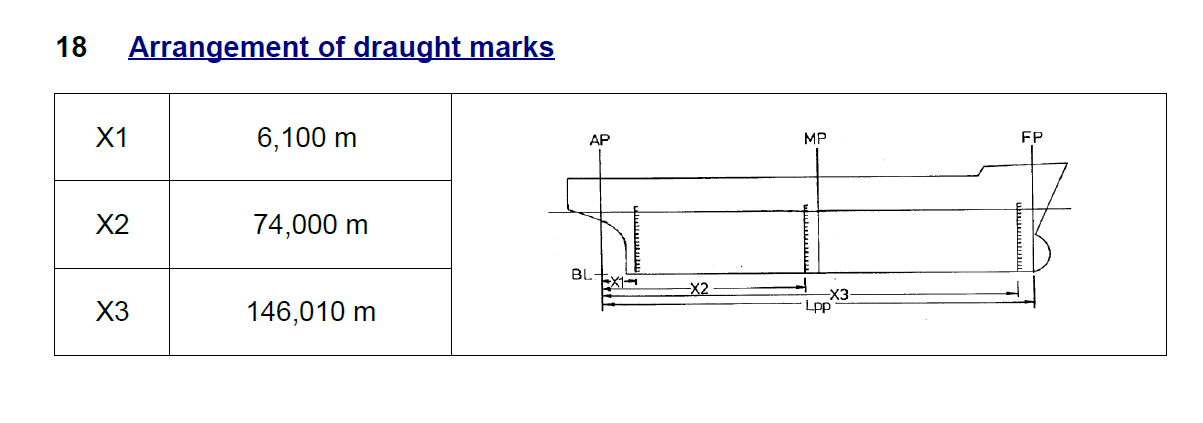
The above picture show you the distance of draft mark to perpendiculars. Some of you may have finds the above arrangement. But how if you find it for the first time? How do you calculate it?

Commonly in the table for draft correction, the distance of draft mark measures to the nearest perpendiculars such as;
Distance of Aft Draft Mark to Aft Perpendicular, Distance of Mid Draft Mark to Mid Perpendicular and Distance of Forward Draft Mark to Forward Perpendicular.
But the above picture shows:
The X1 is represent the Distance of Aft Draft Mark to Aft Perpendicular. (same figure)
The X2 is represent the Distance of Mid Draft Mark to Aft Perpendicular.
The X3 is represent the Distance of Forward Draft Mark to Aft Perpendicular.
Continue reading “Draft Survey: The Other Side”